How to choose Knitted Fabric?
Classification of knitted blank fabrics
First, according to the production method classification
Divided into two categories: weft knitted fabrics and warp knitted fabrics.
Second, according to the composition of raw materials classification
According to the composition of knitted fabric raw materials can be divided into pure spinning knitted fabric, blended knitted fabric and interwoven knitted fabric.
Third, according to the machine shape classification
Divided into flat blank fabric and cylinder blank fabric.
Fourth, according to the processing method classification
Divided into this color cloth, bleached cloth, dyeing cloth, printing cloth, color woven cloth, jacquard cloth.
Fifth, according to the knitted fabric single and double-sided classification
Divided into single-sided knitted fabrics and double-sided knitted fabrics.
Sixth, according to the classification of organizational structure
According to the coil structure and mutual arrangement is divided into: basic tissue fabric, color tissue fabric and composite tissue fabric.
Seven, according to the classification of fabric use
Clothes fabric, decorative fabric, medical fabric, industrial fabric.
Commonly used knitted fabrics and performance
Knitted fabrics used in clothing are mostly weft knitted fabrics. Weft knitted fabric organization is divided into basic organization, fancy organization and composite organization.
Knitted underwear commonly used basic tissue fabrics.
Knitted outerwear is commonly used in fancy and composite organizations. The structure and performance of various tissues are different.
A, knitted underwear fabrics commonly used in the organization, performance and use
1、Weft flat needle organization
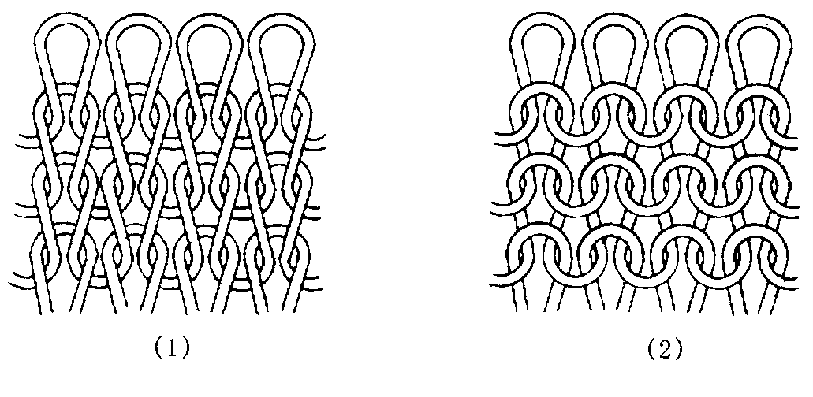
It is the original organization of single-sided weft knitted fabric, which is made of continuous unit loops in one direction in successive series sets. There are positive and negative sides.
Performance: good elongation, and transverse than longitudinal; easy to roll the edge; easy to disperse.
Uses: used for intimate underwear; socks, gloves; transversely used for collar, cuffs and other edge parts rolled edge.
2、Ribbed tissue
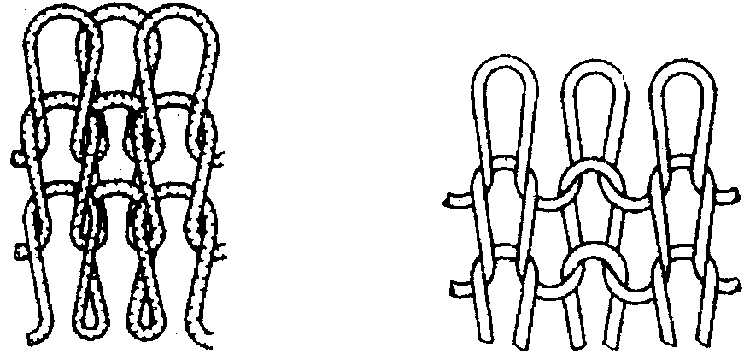
It is the original organization of double-sided weft knitted fabric, which is configured by the longitudinal line of the front coil and the longitudinal line of the reverse coil in a certain combination.
Performance: good transverse extension; good elasticity.
Use: used for intimate underwear; socks, gloves; for collar, cuffs and other edge parts;
3、Double ribbing organization
Commonly known as cotton wool organization, is a kind of double-sided weft knitting change organization, made of two ribbed tissue compound. Both sides of the fabric are in frontal coils.
Performance: elongation and elasticity are smaller than the ribbed tissue, the fabric is thick, not rolled edge, not easy to disperse.
Use: Used for intimate underwear, sportswear and casual wear.
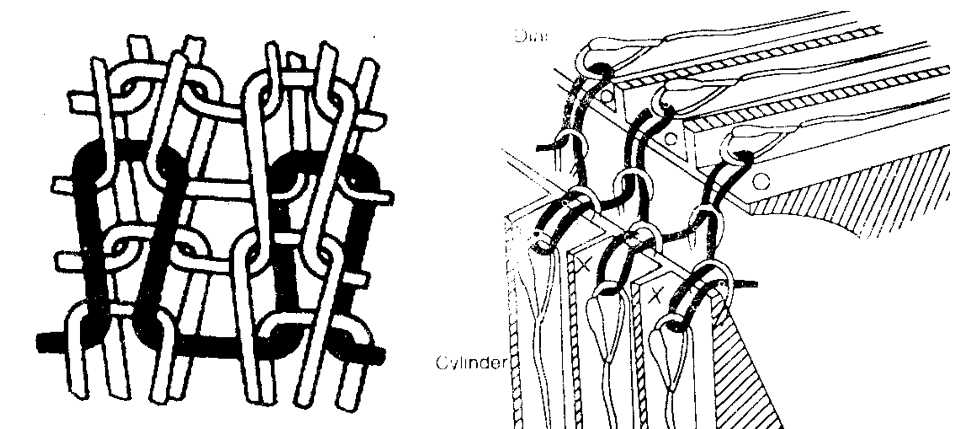
4、Double reverse organization
Is double-sided weft knitting organization is made of front coil horizontal and reverse coil horizontal alternate configuration. Both sides of the fabric are reversed.
Performance: good and close to the longitudinal and horizontal extension of the fabric, easy to disperse, rolled edge with different combinations of positive and negative coil cross-row.
Use: For wool sweater knitting.
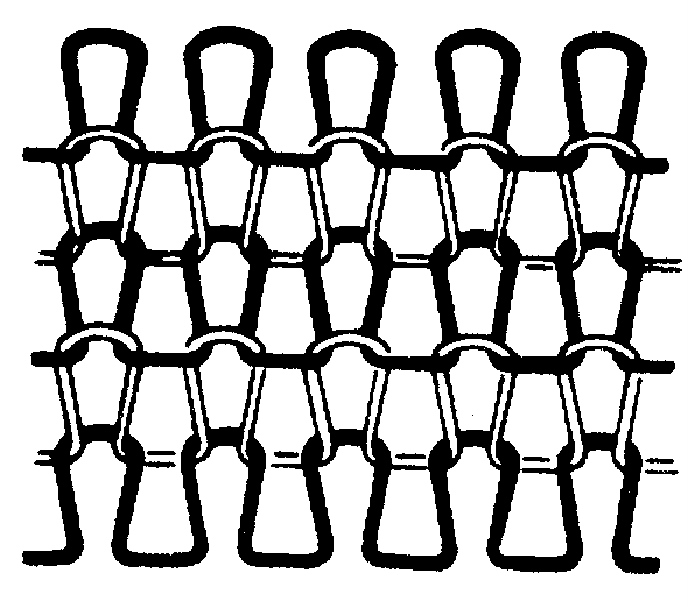
Second, knitted outerwear fabrics commonly used
(A) with the effect of horizontal stripes of fabric
(B) with the effect of longitudinal stripes of fabric
(C) double-sided fabric mesh effect
(D) other fabrics
Knitted fabric performance on the impact of clothing design
Knitted fabric performance, some of the style modeling, sewing processing has an important impact on the design of these properties must be understood before the design, in order to build on the strengths and avoid shortcomings, the rationality of the design, correctness.
I. Stretchability
Knitted fabric stretching can also be called elasticity.
Reasons
1, the coil in the circle column and circle arc transfer .
2, fabric organization.
Disadvantages: size stability is relatively poor, the size of the specifications change.
Advantages: the elasticity is used in the design of body-hugging garments, practice clothes and collars, cuffs, trouser cuffs and other parts.
Countermeasures: Consider in the design, cutting, sewing and ironing process of the style and specification. Such as pulling the cloth, stitching, ironing can not be to the surrounding force, etc..
As well as the use of lining, gauze tape and other methods of reinforcement, to prevent stretching deformation and other processes.
II. Dispersion
When the yarn is broken or the loop loses its connection with the sleeve, the loop is separated from the coil, which is called dispersion.
In the style design and sewing process design, this performance should be fully considered, and take appropriate measures to prevent. Such as the use of overlocked, taut stitching and other anti-dispersion stitching; or the use of rolled edges, rolled edges, leather ribbed edges and other measures to prevent cloth edge dispersion. At the same time, when sewing, care should be taken that the sewing needle does not pierce the yarn to form a needle hole and cause the cloth to fall apart. For this reason, knitted fabrics are generally treated with softness.
The dispersion is related to the type of raw material used in the fabric, the yarn abrasion coefficient, the tissue structure, the unfilled coefficient and the bending stiffness of the yarn. Single-sided weft flat knitting organization dispersion is larger, jacquard fabric, double-sided organization, warp knitting fabric dispersion is smaller or not dispersion.
III. Rolled edge sex
Single-sided knitted fabric in the free state of the edge will produce the phenomenon of package roll, this phenomenon is known as the edge of the volume sex.
This is caused by the internal stress of the bent line segment in the loop attempting to straighten the line segment. When sewing, the rolled edge phenomenon will affect the sewer's operating speed and reduce the efficiency. A spray adhesive is currently used abroad to spray on the fabric edge after opening and cutting to overcome the rolled hem phenomenon.
The rolled edge is related to the tissue structure, yarn twist, tissue density and loop length of the knitted fabric. The general single-sided knitted fabric is more serious edge, double-sided knitted fabric without edge.
IV. Breathability and moisture absorption
The loop structure of knitted fabric can save more air, so the breathability, moisture absorption and warmth are better, and there is a comfortable feeling when wearing.
This characteristic makes it a condition of functional and comfortable fabric, but attention should be paid to ventilation in the circulation or storage of finished products to keep it dry and prevent mildew.
V. Hooking silk and pilling, pilling
VI. Shear resistance
VII. Weft slanting
When the vertical and horizontal rows of circular knitted fabrics are not perpendicular to each other, the phenomenon of weft slope is formed, and the products sewn with such blanks will be twisted and distorted after washing. The weft slant is mainly caused by the twist of the knitting yarn, and the phenomenon will be aggravated by multiple paths at the same time.
VIII. Process shrinkage
Knitted fabric in the sewing process, its length and width direction will occur a certain degree of shrinkage, the amount of shrinkage and the original garment length, width size ratio is called the sewing process shrinkage rate.
The size of the shrinkage is related to the fabric structure, density, raw material type and fineness, dyeing and finishing methods.
The process shrinkage is an important characteristic of knitted fabrics, and the sewing process shrinkage rate is a process parameter that must be considered when designing a pattern.
The extensive application and classification of luminous yarn.
Related Article
840/140
1680/280
2520/420
for your strongest fabric.
Polyester HT 400D
400D 600D 1200D
Webbing, suitcase straps use