Unveiling the Importance and Technical Requirements of Yarn Setting for Perfect Results
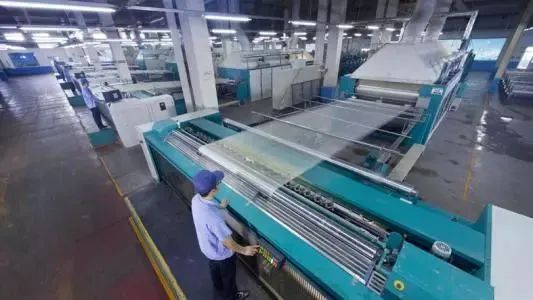
Why do yarns need to be sized? What are the requirements?
Warp yarns are subjected to a variety of forces and complex deformations during weaving. In terms of the basic motion of the loom.
(1) During the opening movement, the warp yarn is bent into a fold at the heald eye from a largely straight heald line, and elongation occurs proportional to the square of the bobbin height. At the same time, the warp yarn slips inside the heald eye due to the asymmetrical length of the front and back of the shuttle opening, creating friction. When the upper and lower warp yarns are raised and lowered alternately in the opening motion, a violent friction occurs between them.
(2)When leading weft movement, the shuttle of the shuttle loom is supported by the shuttle opening, and friction is caused by the friction between the shuttle, especially when entering and leaving the shuttle opening, which has a large degree of extrusion on the side warp, causing bending, elongation and friction, and the weft guiding part of the shuttle loom has considerable friction on the warp.
(3) When playing weft movement, the warp yarn at the front of the shuttle is rubbed by the reed teeth in reciprocating movement. Due to the weaving shrinkage, the squeezing friction between the reed teeth and the side warp is even more intense. In the weaving mouth weft beating area, each weft beating caused by the back and forth movement, will increase the friction between the warp yarn and the heald eye.
(4) In the warp feeding and winding movement, the warp yarn on the weaving beam is always sent out with a certain braking tension. Most of the existing warp feeding mechanisms are tension-adjusted warp feeding mechanisms, which control the amount of warp feeding by means of sensing feedback of the warp tension. Therefore, warp yarns with weak knots start to break when they pass through the back beam. The winding motion also affects the warp tension and forms an elastic-plastic deformation system with the warp feeding, weft beating and opening.
Thus, the warp yarn is subjected to forces and deformations during the weaving process, which are mainly formed by tension (required not to cause breakage), elongation (cyclic deformation can be returned) and friction (not to pile, pilling, grinding off).
At the same time, it is worth paying attention to the hairiness problem. In the warp yarn opening, the outstretched hairiness will be entangled with each other, making the opening unclear and causing defects such as jumping yarn, jumping flower and hanging warp that are difficult to eliminate. In the air-jet loom wefting, the opening is unclear causing weft blocking, but also affect the efficiency of the main factors. Therefore, the reduction of hairiness is an important indicator.
In view of the above, in order to improve the weaving performance of the warp yarn, weaving preparation project is an effective way to sizing. This means that the warp yarn is subjected to a slurry of adhesive material, which is applied to the surface of the warp yarn to a certain depth and dried to form a sizing structure with the yarn as a whole.
The improvement of warp performance after sizing should be enhanced, tensile, abrasion resistant, and close to the hairiness. By sizing, filament yarns make single filaments stick to each other, have bunching, prevent filament pilling or head breakage, and inhibit the elasticity of filaments for easy handling. Staple warp stretch yarns and strong twist yarns also need to be sizing to suppress shrinkage in order to produce smoothly. The ultimate goal of sizing is: good sizing axis, less weaving defects, low head breakage, high weaving efficiency and improved weaveability of warp yarns.
Specific requirements are:
(1) Increase the yarn breaking strength. It is necessary to increase the strength appropriately, but if the increase of the strength of the sizing yarn is pursued excessively, it will inevitably make the yarn hard and brittle and lose its elasticity, and it will break easily. The enhancement rate of pure cotton yarn is generally controlled at 25% to 40%, polyester/cotton yarn l0% to 25%, pure polyester yarn 10% to 20%, polyester/viscose and pure viscose yarn >25%.
(2) Maintain yarn elongation at break. The elongation of the original cotton yarn is generally 7% and should be kept at 4%-5% after sizing to facilitate weaving, so the elongation reduction is ≤ 30%, polyester/cotton and polyester/viscose yarns ≤ 25%, and pure viscose yarns ≤ 35%.
(3) Improve the abrasion resistance. As the abrasion resistance test has not yet been standardized, the abrasion resistance of various sizing formulations also varies greatly.
(4) Hairiness reduction rate. Using YGl7lB type yarn hairiness tester and BT a 2 type online hairiness tester, the advanced index of hairiness reduction rate is more than 75% for yarn hairiness comparison before and after sizing.
(5) Weaving shaft good shaft rate. It is required that the sizing yarn has no inverted broken head, multiple head, sticky and stranded head, light sizing hair pilling, weaving without pulling edge and other defects, and the advanced level of good shaft rate is more than 60%.
(6) Weaving machine broken warp number. Shuttle loom should be in 1 / (unit - h) below, shuttleless loom 100,000 weft broken warp number required 10-15 below.
As a printing and dyeing finishing of the blank, in addition to the requirements of weaveability, but also requires easy desizing, and desizing waste liquid to the environment without pollution. It must be considered in the selection and proportioning of the sizing material.
As a finished fabric, it is required to give the fabric a unique style and handfeel, and must be properly adjusted in terms of the type of pulp, oiling agent and sizing rate.
Exploring the Six Marvelous Characteristics and Applications of Nylon Fiber
A major breakthrough in the textile industry: Exploring the advantages of acetate fiber
Related Article

840/140
1680/280
2520/420
for your strongest fabric.
Polyester HT 400D
400D 600D 1200D
Webbing, suitcase straps use